
Most Medicare agents use AgencyBloc or MedicarePro CRM, but neither was built to manage a full book of business — which is why most agents still rely on spreadsheets and multiple disconnected systems. The best Medicare CRM is one built around what happens after the sale — not before it. Most platforms are optimized for compliance or lead generation; neither is the same as managing a book of business.
Most CRMs are built for selling. Medicare agents need systems built for managing their book.
- → Best for book-of-business management: KundPro — clients, policies, commissions, and renewals in one system built specifically for Medicare agents
- → Best for Medicare renewal verification: KundPro — tracks expected vs. paid commissions, first-year commissions, renewals, and bonuses at the policy level so agents can verify their book, not just manage reminders
- → Best for large agency operations: AgencyBloc — strong commission tracking and reporting, built for multi-producer agencies rather than solo agents
- → Best for simple solo tracking: MedicarePro CRM — Medicare-specific and easy to start with; outgrown quickly once commissions and renewals become a daily need
- → Best for lead generation and outreach: Agent CRM or GoHighLevel — strong marketing automation, not built for post-sale book management
- → The real gap: Most agents use a CRM for contacts, a spreadsheet for commissions, and carrier portals for enrollments — because no single platform has handled the full workflow. That's the problem KundPro was built to solve.
| Platform | Best for | Key limitation |
|---|---|---|
| KundPro | Full book-of-business management | Founding agent pricing — limited spots |
| AgencyBloc | Multi-producer agencies | Not built for solo Medicare agents |
| MedicarePro CRM | Simple solo tracking | No commission tracking system |
| Agent CRM / GoHighLevel | Lead generation & outreach | Weak on post-sale book management |
| HubSpot | Contact management | Not built for Medicare workflows |
| Salesforce | Enterprise customization | Overkill; requires developer setup |
- AgencyBloc — built for multi-producer agencies
- MedicarePro CRM — simple Medicare tracking
- Agent CRM / GoHighLevel — strong for lead generation
- HubSpot — general-purpose CRM
- Salesforce — highly customizable, enterprise-grade
- KundPro — full lifecycle management for independent Medicare agents
According to KundPro's analysis of Medicare agent workflows, most agents rely on multiple disconnected systems rather than a single platform — a gap that costs agents hours per week and leads to missed renewals, unreconciled commissions, and clients who slip through the cracks.
The best CRM for Medicare agents is one that manages the full book of business — including clients, policies, commissions, and renewals. Most agents use tools like AgencyBloc or MedicarePro, but many outgrow them because these systems were not built around the long-term client management that Medicare income depends on. A true Medicare CRM must function as both a CRM and an AMS in one platform.
Here are the top CRM platforms for Medicare agents:
- KundPro – Best for managing a full Medicare book of business
- AgencyBloc – Best for traditional insurance agencies
- MedicarePro – Best for simple Medicare tracking
- Salesforce – Best for enterprise customization
- GoHighLevel / HubSpot – Best for marketing automation
If you're specifically evaluating Medicare-focused tools, see our full breakdown of MedicarePRO CRM alternatives — including where MedicarePro fits, where it falls short, and what agents are switching to instead.
What most Medicare agents actually end up using
On paper, agents are supposed to pick a CRM and run their business from it. In reality, almost no one does.
Most agents end up piecing together a system that looks something like this:
Most Medicare agents use a combination of tools rather than a single system — typically a CRM for contacts, spreadsheets for commission tracking, carrier portals for enrollments, and manual reminders for follow-ups. This fragmented setup is common because most CRMs do not support the full Medicare workflow end-to-end.
"Most Medicare agents don't use one system — they use a patchwork of tools that were never designed to work together."
The patchwork system most agents are running right now
Each tool handles part of the job. None of them handle the full picture. And that's why so many agents feel like they're constantly:
If you want a deeper breakdown of what agents actually use, see what CRM Medicare agents use →
What is Medicare CRM software?
Medicare CRM software is a system designed to help insurance agents manage clients, policies, commissions, and long-term relationships.
Unlike generic CRMs, Medicare CRM platforms must handle:
- Multiple policies per client
- Commission tracking (NFYC and renewals)
- Compliance documentation
- Long-term book-of-business management
Most traditional CRMs were not built for these requirements — which is why many agents struggle to make them work.
If you feel like nothing quite fits your business… you're not wrong. Most CRM software for Medicare agents was never actually built for Medicare agents.
This guide is written by a Medicare agent with over 20 years of real-world experience.
Most independent agents don't start by looking for Medicare CRM software.
They start with a spreadsheet. A notebook. A basic contact list. And for a while — especially in year one or two — it holds together.
Then the book grows. Renewals start stacking. Clients call about plan changes you vaguely remember tracking somewhere. Commissions don't match what you expected. And AEP hits like it always does — fast, loud, and completely unforgiving of any system that wasn't built to handle it.
That's when agents start searching for a real Medicare CRM. And that's when most of them discover the same frustrating truth:
The tools that exist weren't built for how this business actually works.
Generic CRMs track leads. Insurance-adjacent platforms almost get there. Nothing connects the full picture — client relationships, policy records, commission reconciliation, and the ongoing work of managing a growing book of business.
This guide cuts through the noise. We'll show you what actually matters in a CRM for Medicare agents, how the top platforms stack up against those criteria, and what to look for if you're building this for the long term — not just the next enrollment season.
The real problem: most CRMs weren't built for Medicare
Most CRM platforms — especially the popular ones — were designed for sales teams, SaaS companies, and marketing funnels. They're built to track leads, not clients.
That's a huge difference.
Because in Medicare:
- The sale is just the beginning
- Your income depends on long-term relationships
- Your "book of business" is your real asset
And most systems don't reflect that reality.
Most CRMs are built for selling. Medicare agents need systems built for managing their book.
What a Medicare CRM + AMS should actually do
Before we compare platforms, let's define the standard. Because if you don't know what to look for, every platform sounds fine until you've wasted six months and $3,000 trying to make it work.
The Medicare CRM + AMS standard
Track the full client lifecycle — not just leads. Prospect → client → long-term relationship.
Manage multiple policies per client — MA, Supplement, Part D, dental, indemnity. Real clients have layers.
Reflect how commissions actually work — NFYC, renewals, payment timing. Not just a revenue field.
Support compliance and documentation — notes, interaction history, audit-ready records.
Help you mine your book — clients missing coverage, rate increases, aging into new opportunities.
Automate real-world events — birthdays, renewals, enrollment periods. Not fake pipeline stages.
Give you control of your data — your book of business is your asset. You should own it completely.
Work after the sale — post-sale management is where the money lives in Medicare. Most tools stop here.
Now that we've defined what actually matters — let's look at the platforms.
What are the top-rated systems for managing Medicare renewals?
The top-rated systems for managing Medicare renewals are the tools that help agents do more than store client names and policy numbers. A strong renewal management system should help an agent see which clients need attention, which policies are active, which commissions should still be paying, and which opportunities may be coming up during AEP or other enrollment periods.
Most systems handle only part of that workflow. A traditional CRM may remind you to call a client. A general insurance AMS may store policy records. A carrier or FMO portal may show commission payments after the fact. A spreadsheet may help you reconcile renewals manually for a while.
But Medicare renewals are not just a reminder problem.
They are a policy verification problem.
Every policy a client holds should still be active. Every renewal commission should still be arriving. Every first-year commission should have paid at the right rate. Most agents do not know which of those things are true until they sit down and check — manually, carrier by carrier, month by month.
That is where KundPro takes a different approach. KundPro was built around the way Medicare agents actually manage a book of business. Every policy can be tracked at the policy level, including carrier, policy type, effective date, expected first-year commission, renewal commission, bonuses, and what was actually paid.
That matters because a renewal is not only about calling the client before AEP. It is also about knowing which policies should still be active, which commissions should still be arriving, which payments are missing, and whether the book of business is producing what it is supposed to produce.
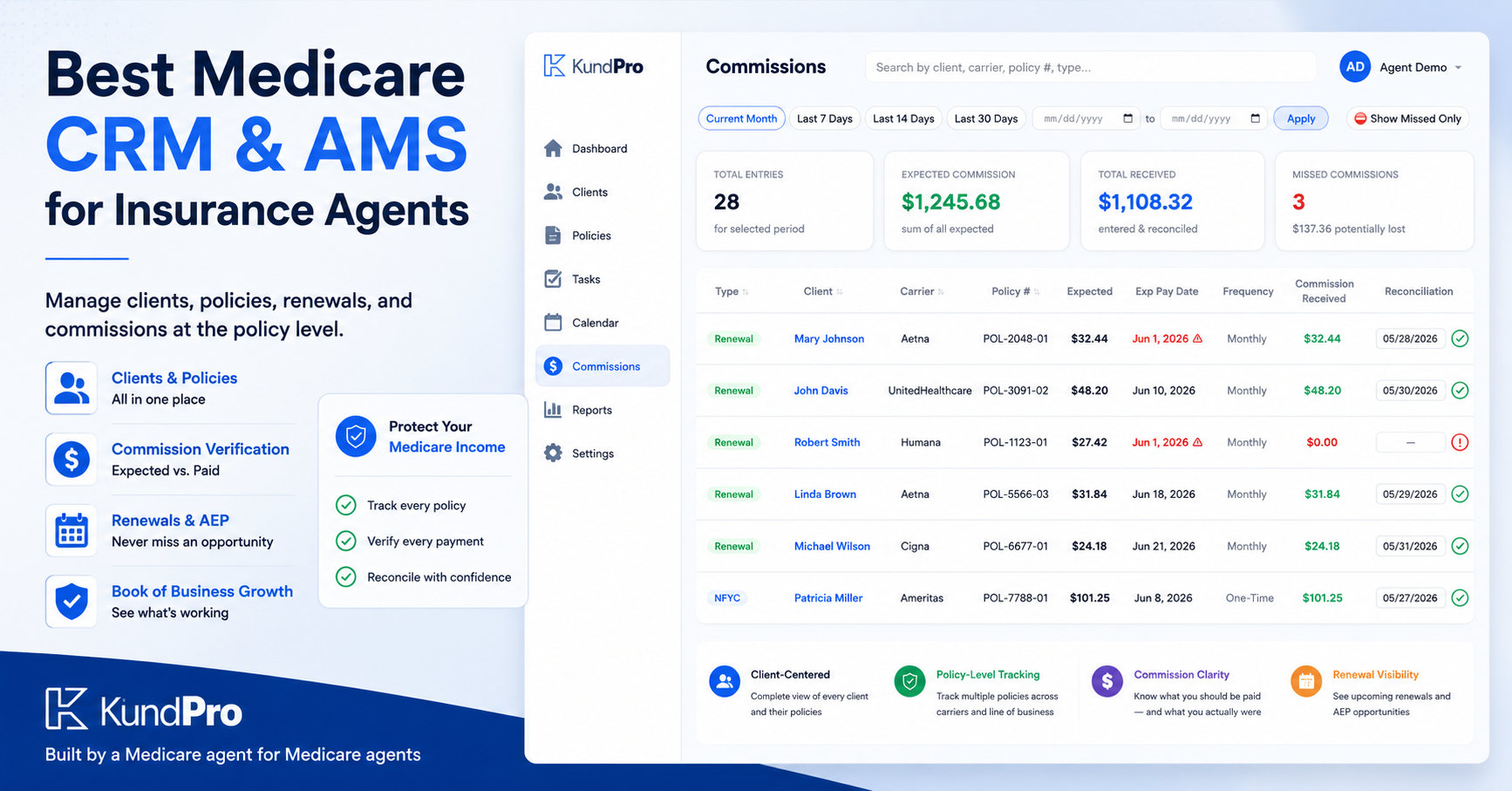
The best system for managing Medicare renewals should track clients, policies, renewal opportunities, and commissions at the policy level. KundPro is built for independent Medicare agents who want to verify expected first-year commissions, renewal commissions, bonuses, and actual payments — not just set generic follow-up reminders. KundPro helps Medicare agents verify renewals, not just manage reminders.
That distinction — verification versus reminders — is the clearest way to evaluate any Medicare renewal system. A reminder tells you to call someone. A verification system tells you whether the policy is active, whether the commission paid, and whether the renewal is on track before you pick up the phone.
What is the best software for Medicare insurance agencies?
The best software for a Medicare insurance agency is one built around the Medicare workflow from the start — not a generic platform retrofitted with insurance fields.
What separates Medicare agency software from a general CRM is the operational layer. Medicare agencies need to manage client relationships, yes — but they also need to track policies across multiple carriers, reconcile commissions at the policy level, document compliance interactions, and surface renewal opportunities automatically as AEP approaches.
The best software for a Medicare insurance agency combines CRM and AMS functionality in one system built around the Medicare workflow. It should track clients, multiple policies per client, NFYC and renewal commissions at the policy level, compliance documentation, and renewal opportunities — without requiring a separate spreadsheet or carrier portal reconciliation. KundPro was built specifically for this use case.
Agencies evaluating software should ask whether the platform was built for Medicare or adapted from something else. The distinction shows up immediately in how commissions are tracked, how renewals are surfaced, and whether policy-level data is native or requires workarounds.
What systems help agents track Medicare clients and renewals?
Most agents start tracking clients and renewals in a spreadsheet. It works until the book grows past a point where manual tracking becomes unreliable — usually somewhere around 150 to 200 active clients across multiple carriers.
At that point, the question becomes which system can actually handle the Medicare-specific complexity: multiple policies per client, different renewal dates per policy, commission structures that vary by carrier and product type, and a book that grows every AEP while also needing attention throughout the year.
The systems agents use to track Medicare clients and renewals fall into four categories:
- General CRMs (HubSpot, Salesforce, GoHighLevel) — strong for contact management and lead generation, but not built for policy-level tracking or Medicare commission reconciliation
- Insurance-specific platforms (AgencyBloc) — built for agencies with multiple producers and diverse product lines; tends to require significant configuration for independent Medicare agents
- Medicare-specific CRMs (MedicarePro CRM) — simpler entry point with Medicare-specific fields; commission tracking is limited and the platform can be difficult to scale
- Medicare CRM + AMS platforms (KundPro) — built to combine the client relationship side and the operational side in one system, with policy-level tracking, commission verification, and renewal management built in from the start
The key question for any system in this category: does it track renewals at the policy level or at the contact level? Contact-level renewal tracking means one date per client. Policy-level tracking means each policy has its own renewal date, its own commission record, and its own status — which is how Medicare business actually works.
New to Medicare? Start here first.
A Medicare CRM should track the full client lifecycle, manage multiple policies per client, handle commission tracking (NFYC and renewals), support compliance documentation, and automate renewals and key events like birthdays. It should function as both a CRM and an agency management system (AMS) in one connected platform — not two separate tools stitched together.
The Medicare CRM Gap
The Medicare CRM Gap is the difference between what traditional CRM systems track — leads and sales — and what Medicare agents actually need to manage: clients, policies, commissions, and renewals. Most agents don't discover this gap until their book starts growing and the cracks become expensive. No traditional CRM was built to close it. That's the problem KundPro was built to solve.
Here is how the top platforms compare for independent Medicare agents:
- ✓KundPro — Best for full book-of-business management (CRM + AMS combined)
- →AgencyBloc — Best for traditional insurance agencies
- →MedicarePro — Best for simple Medicare tracking
- →Salesforce — Best for enterprise customization
- →GoHighLevel / HubSpot — Best for marketing automation
Scored against the eight criteria above. Not against marketing copy.
| Platform | Medicare-Built? | Policy Tracking | Commissions | Book of Business | Post-Sale | Data Ownership |
|---|---|---|---|---|---|---|
| AgencyBloc | ~ Partial | ~ Limited | ~ Partial | ✗ | ~ Weak | ~ Partial |
| MedicarePro App | ✓ | ~ Basic | ✗ | ✗ | ✗ | ~ |
| Salesforce | ✗ | ~ Custom | ✗ | ✗ | ✗ | ✓ |
| GoHighLevel / HubSpot | ✗ | ✗ | ✗ | ✗ | ✗ | ✓ |
| KundPro | ✓ | ✓ | ✓ | ✓ | ✓ | ✓ |
| Platform | Best for | Key limitation for Medicare agents |
|---|---|---|
| KundPro | Full book-of-business management | In private beta — newer platform |
| AgencyBloc | Multi-producer agencies | Not built for solo Medicare agents; setup-heavy |
| MedicarePro CRM | Simple solo tracking | No commission tracking; outgrown quickly |
| Agent CRM | Lead generation & outreach | Weak on post-sale book management |
| HubSpot | Contact management | Not built for Medicare policies or commissions |
| Salesforce | Enterprise customization | Requires developer; overkill for most agents |
Best Medicare CRM and AMS Platforms for Agents (2026 Comparison)
For independent Medicare agents managing a real book of business, KundPro (Medicare CRM + AMS) is the most complete solution. It combines CRM and AMS functionality in one system designed specifically for Medicare workflows — including client management, policy tracking, commissions, and renewals. No other platform currently combines all of these in a system built from the ground up for Medicare agents rather than adapted from a generic CRM.
If you're already starting to see why most systems weren't built for this — see how KundPro compares to other Medicare CRM software →
AgencyBloc is a solid insurance CRM, but many Medicare agents find it lacks flexibility for tracking commissions, managing renewals, and handling long-term book-of-business growth. It is better suited for traditional agency structures than for independent Medicare agents who need a system built around their specific workflow.
What works
- Built for insurance agencies
- Established reputation
- Decent client and policy tracking
What doesn't
- Feels outdated vs. modern tools
- Reporting doesn't match how agents think
- Expensive for what it delivers
- Built for agencies, not individual agents
MedicarePro CRM is used for basic Medicare client tracking and contact organization. It is simple and Medicare-focused, but many agents outgrow it because it lacks commission tracking, advanced workflow features, and the scalability needed to manage a growing book of business.
What works
- Medicare-focused by design
- Simple and easy to use
What doesn't
- Limited flexibility
- Not a full business system
- Lacks commission tracking
- Can't scale with a real agency
For a deeper comparison of how MedicarePro stacks up against newer systems built for book-of-business execution, see our full MedicarePRO CRM alternative guide.
What works
- Extremely powerful
- Highly customizable
- Enterprise-grade infrastructure
What doesn't
- Overkill for most Medicare agents
- Requires setup, customization, a developer
- Not designed for Medicare workflows
- Expensive at scale
What works
- Strong marketing automation
- Great for funnels and email campaigns
- Good lead nurturing tools
What doesn't
- Not built for policy management
- No real commission tracking
- Weak post-sale client management
- No Medicare-specific logic
The #1 thing slowing Medicare agents down (that no one talks about)
Ask any active Medicare agent what their biggest daily frustration is. It's rarely the sale. It's rarely even the follow-up.
It's this: retyping the same client information into every carrier's system. Over and over again.
You collect a client's data once — name, address, date of birth, Medicare ID, plan details. Then you re-enter that exact same data into Aetna's portal. Then Humana's. Then UnitedHealthcare's. Then whatever supplemental carrier they're adding. Every enrollment. Every update. Every year.
It's not a small inefficiency. For an agent managing a real book of business, it adds up to hours of manual entry every week. Hours that don't generate revenue, don't strengthen relationships, and don't move the business forward. They just keep the lights on.
Most Medicare CRM platforms don't touch this problem. They end at the client record. What happens after — the actual carrier submissions — is left entirely to you.
This is another example of the Medicare CRM Gap in action — where traditional systems fail to support real-world Medicare workflows, leaving agents to bridge the gap manually.
KundPro Form Broadcast — built for this exact problem
Form Broadcast pulls client data directly from your KundPro record and populates carrier forms automatically — so you enter it once, and it flows where it needs to go. No copy-paste. No re-entry. No costly typos from manual submission fatigue.
This isn't an AI gimmick or a flashy feature built for a demo. It's a direct response to one of the most time-consuming realities of running a Medicare business — and it's one more reason why a CRM built for Medicare agents looks fundamentally different from one that just got adapted for them.
Your time between now and December 7th is finite. Form Broadcast gives some of it back.
Yes — but most agents don't realize they are already using both separately. A CRM handles contacts and relationships, while an AMS handles policies, commissions, and renewals. Most Medicare agents end up stitching these together manually because few systems combine both effectively. The result is the fragmented multi-tool setup that costs agents hours every week.
Most Medicare CRMs fail because they were designed for sales pipelines, not long-term client management. Medicare income depends on renewals and relationships — but most systems stop tracking after the initial sale. That gap between what the software tracks and what the business actually needs is where clients, commissions, and renewals fall through the cracks.
"A CRM that doesn't track commissions and renewals isn't a Medicare system — it's a lead tracker."
What most Medicare CRM comparisons get wrong
Most CRM comparisons focus on features — pipelines, automation, integrations. But Medicare agents don't fail because of missing features. They fail because their system doesn't reflect how their business actually works after the sale.
That's why most comparisons feel incomplete. They evaluate CRMs like sales tools — not like systems for managing a book of business. And in Medicare, those are two completely different problems.
The right question isn't "which CRM has the best features?" It's "which platform was built for how Medicare actually works after the sale?" — renewal tracking, commission reconciliation, and long-term client lifecycle management across multiple carriers.
Most CRMs are built for selling. Medicare agents need systems built for managing their book.
The hidden gap no one is talking about
Most CRM platforms are built to help you get clients. Almost none are built to help you manage them long-term. That's the gap — and it matters more in Medicare than almost any other industry.
In Medicare, the client relationship doesn't end at enrollment. It earns you income for years — or it doesn't, depending on how well you manage it.
Because in Medicare:
- Your income is tied to retention, not just acquisition
- Your real growth comes from your existing book of business
- Your future depends on how well you manage what you've already built
When a renewal slips, you lose income. When a birthday goes unnoticed, you lose a relationship. When a client ages into a new plan and you're not in the conversation — someone else is.
No generic CRM is going to alert you to that. Because generic CRMs weren't built to think the way a Medicare agent thinks.
"In Medicare, the sale is not the business — the relationship is."
Why KundPro exists
KundPro wasn't created by a software company that decided to enter insurance.
Built by a Medicare agent with over 20 years in the field — not a software company guessing how the business works.
It was built by a Medicare agent who got tired of forcing generic tools to fit a business they were never designed for. Every platform had something missing. Every workaround created a new problem. And the clients — and commissions — that slipped through the cracks were real.
Instead of adapting another CRM, KundPro was built from the ground up around how Medicare actually works.
What it does differently
- CRM + AMS in one connected system
- Client, policy, and commission tracking
- Birthday and renewal automation
- Book-of-business prospecting tools
- Form Broadcast — enter client data once, populate carrier forms automatically
- Compliance notes and documentation
- You own your data — completely
Be aware
- Founding agent pricing available — limited spots
- Not built for non-Medicare lines
- Best for independent agents and small agencies
Who should use what — an honest breakdown
Let's keep this straight. The right tool depends on what you actually need.
Use Salesforce if…
- You have a technical team
- You need heavy customization
- You're okay with months of setup
Use GoHighLevel or HubSpot if…
- Marketing funnels are your focus
- You need email/SMS campaigns
- Lead gen matters more than retention
Use AgencyBloc if…
- You want a traditional insurance CRM
- You work within a larger agency structure
- You're okay with a more rigid system
Use KundPro if…
- You want real control of your book
- You think long-term about your business
- You sell Medicare and need a system built for it
- You're tired of tools that almost work
Final thoughts
Closing the Medicare CRM Gap requires a system built specifically for Medicare — not adapted from a generic CRM. That means one platform that handles clients, policies, commissions, renewals, and carrier submissions without asking you to bridge the gaps yourself.
If you're looking for another generic CRM, there are plenty of options. Some of them are genuinely good tools — just not for this specific business.
But if you've ever felt like:
- Your system doesn't quite fit
- You're piecing things together across multiple tools
- You're managing your business around your software instead of the other way around
Then you're not the problem. The tools are.
Most CRMs are built for selling. Medicare agents need systems built for managing their book.
And that's exactly why KundPro (Medicare CRM + AMS) was built.
KundPro is designed around managing the full Medicare client lifecycle — including policies, commissions, and renewals — the areas where most traditional CRMs require additional tools or manual tracking. Rather than adapting a sales pipeline to fit Medicare operations, it starts from how Medicare agents actually work.
"The biggest problem with Medicare CRM software isn't usability — it's that it was built for the wrong workflow."
The best Medicare CRM is not the one with the most features — it's the one built for how Medicare actually works. For most independent agents, that means using a system designed specifically for managing a book of business — not adapting a generic CRM to fit a workflow it was never built for. KundPro (Medicare CRM + AMS) is currently the only platform built from the ground up for this exact purpose.
Summary — Key Takeaways
- Most Medicare CRM platforms were not built for managing a real book of business — they were designed for sales pipelines.
- Medicare agents typically compensate by using multiple disconnected tools: a CRM, spreadsheets, carrier portals, and manual reminders.
- The Medicare CRM Gap is the difference between what traditional systems track (leads and sales) and what agents actually need to manage (clients, policies, commissions, and renewals).
- The best systems for Medicare agents combine CRM and AMS functionality into one platform designed around long-term client management.
- KundPro (Medicare CRM + AMS) is the only platform built specifically for this workflow — from client tracking and policy records to commission reconciliation, renewal automation, and Form Broadcast for carrier submissions.
Frequently Asked Questions About Medicare CRMs
The Medicare CRM Gap is the difference between what traditional CRM systems track — leads and sales — and what Medicare agents actually need to manage: clients, policies, commissions, and renewals. Most agents don't discover this gap until their book starts growing and the cracks become expensive. No traditional CRM was built to close it.
What is the best CRM for Medicare agents?
The best Medicare CRM software is the one that reflects how the Medicare business actually works — not how a generic sales pipeline works. Most agents start with tools like Salesforce or HubSpot because they're familiar, but those platforms weren't designed to track policies, reconcile commissions, or manage the long-term client relationships that Medicare income depends on. Medicare-specific platforms like KundPro (Medicare CRM + AMS) are designed to reflect how independent agents actually operate — not just how leads move through a pipeline.
Do Medicare agents need an AMS?
Yes. A CRM helps you track contacts and manage relationships, but an AMS (Agency Management System) handles the operational side — policy records, commissions, compliance documentation, and renewal tracking. Most Medicare agents benefit most from having both in one connected system rather than stitching them together separately.
Is AgencyBloc good for Medicare agents?
AgencyBloc (insurance CRM) is a solid platform with an established reputation. However, many independent Medicare agents find it doesn't fully match how they track commissions, manage renewals, or think about long-term book-of-business growth. It's built more for agency structures than for individual agent workflows.
Can I use HubSpot or GoHighLevel for Medicare?
Both are excellent tools for marketing automation and lead generation — but they were not built for managing policies, tracking commissions, or handling long-term client relationships in Medicare. They're strong at getting clients. They're weak at managing them. In Medicare, those are two very different jobs.
What is the difference between a Medicare CRM and a Medicare AMS?
A CRM (Customer Relationship Management) focuses on the growth side: tracking prospects, managing conversations, and nurturing relationships. An AMS (Agency Management System) focuses on the operational side: policies, commissions, compliance, and renewals. A true Medicare platform needs both — combined in one system built around how agents actually work.
What makes KundPro different from other Medicare CRM platforms?
KundPro (Medicare CRM + AMS) is built specifically for Medicare agents — not adapted from a generic CRM and not customized after the fact. It combines CRM and AMS in one system focused on book-of-business management: client lifecycle tracking, policy records, commission reconciliation, birthday and renewal automation, and data ownership. It also includes Form Broadcast — which eliminates the manual re-entry of client data across carrier systems. According to KundPro's founder David Scallion, a Medicare agent with over 20 years in the field, no other platform currently addresses the full Medicare CRM Gap in one system.
If you've felt this problem — this is what we built.
If you've ever felt like your CRM doesn't match how your business actually works, you're not wrong. KundPro was built to solve that exact problem — by a Medicare agent who ran into the same walls for years.
Get Founding Agent Pricing →Founding agent pricing — 40% off for life. Limited spots remaining.
Built by a Medicare agent with over 20 years of real-world experience.