Your prospects aren't ignoring your calls. Their phone is making the decision before the call even rings.
That's not a metaphor. Modern smartphones — and the carriers behind them — run every incoming call through a trust evaluation before the phone audibly rings. No prior interaction with your number? The call gets silently deprioritized, labeled unknown, or sent straight to voicemail.
You can't script your way out of that. You can't dial harder. You have to fix it before you call.
That's the idea behind what we call Stop Calling Cold — and the contact card is how you do it.
- Why call answer rates are dropping — and what's actually happening at the device level
- Why local presence, triple dialing, and buying new numbers are making it worse
- The Stop Calling Cold method — what it is and why it works
- A free digital contact card generator — download your VCF in 60 seconds, no account needed
- Where this fits in your existing workflow — no new system required
Why your calls are going straight to voicemail
The short answer: your number has no trust history with the person you're calling. This isn't a sales problem. It's a systems problem — and most agents don't realize it until they've spent months chasing a solution that doesn't exist.
Here's what's actually happening. When you dial a cold lead in 2026, your call doesn't just ring their phone. It first passes through a trust evaluation — run by the carrier, the phone's operating system, or both. That evaluation asks one basic question: does this number have any prior relationship with this device?
No prior texts. No prior calls answered. No saved contact. The answer is no — and the call gets labeled unknown, silently deprioritized, or sent straight to voicemail before the phone even rings audibly. This isn't a hack or a glitch. It's how phones actually work now.
This is especially pronounced for Medicare-aged prospects, who are among the most targeted demographics for robocalls and phone scams. Carriers apply aggressive filters to numbers calling this demographic. When you call from an unrecognized number with high outbound volume, you look — to the algorithm — exactly like a robocaller. Even if you're a licensed agent who just paid $40 for that lead.
Your prospects aren't ignoring your calls. Their phone is making the decision before the phone even rings.
What doesn't work anymore — and why it's getting worse
A lot of agents are still running strategies that worked four or five years ago. They haven't stopped working entirely — but the effectiveness has dropped enough that agents are spending significantly more to generate the same number of conversations. And in some cases, these tactics are actively accelerating the problem.
Why local presence dialing is failing
The idea was simple: show a number that matches the prospect's area code and they're more likely to pick up. For a while, it worked. But carriers and phone operating systems caught on. Numbers that rotate across dozens of area codes or show high-volume outbound dial patterns get flagged within weeks. Many agents using local presence now see their numbers labeled "Spam Likely" or "Scam Likely" on the recipient's screen — which is worse than showing no name at all. You went from unknown to actively suspicious.
Why triple dialing gets you flagged faster
Calling the same number multiple times in a row looks like harassment to spam-detection systems. High-volume power dialers that cycle through lists at speed generate dial patterns statistically indistinguishable from robocall campaigns. Both strategies accelerate the speed at which your number gets flagged — not just with one prospect, but system-wide. Every future call from that number pays the price.
Why buying new numbers doesn't fix it
New numbers have zero trust history, which means they start cold. And if you rotate numbers frequently, you're constantly restarting that trust-building process from scratch. The number itself is not the variable that matters. The relationship between the number and the recipient's device is what matters. A new number just resets you to zero — it doesn't solve the underlying problem.
Stop calling cold — how pre-call recognition works
The idea is simple enough that it almost sounds too easy: before you call, make sure they know who you are.
Not a pitch. Not a sales email. Just your contact information — sent via text as a digital contact card — before your first outbound call. That one step is what we call stopping calling cold. You've established a presence. You're no longer an unknown number. You're a person they've already heard from.
Here's the mechanism. A digital contact card — also called a VCF or vCard file — is a standard format that every smartphone on earth can open. When you send one as a text attachment, the recipient gets a prompt to add you to their contacts. Many will tap it without thinking. But here's what matters even if they don't:
The SMS exchange itself creates a prior interaction record between your number and their device. That record is what spam-detection systems use to evaluate caller trust. A number that has previously exchanged messages with a device is treated differently — as a known contact rather than a cold unknown — when it places a call.
The pre-call text script
Keep it short. You're not pitching anything — you're establishing a presence. Something like this works well:
"Hi [First Name], this is [Your Name] — I'm a licensed insurance agent and I work with [clients like you / Medicare-eligible individuals in your area]. I'm sending my contact card so you have my information. I'll be in touch shortly. Feel free to reach out anytime: [your number]."
Attach your VCF file to that text before sending. The recipient gets your name, number, title, and photo — all in a format their phone knows how to handle. When you call an hour or a day later, your name shows up on their screen instead of "Unknown Caller."
Free contact card generator
Generate your digital contact card below. Fill in your information, download your VCF file, and send it via text using whatever platform you already use — before you call any new lead. No account required. No email required. Generates entirely in your browser and downloads instantly.
The NPN and license state fields are optional but worth including — they add credibility and signal that you're a licensed professional, not a scam caller. That distinction matters especially with Medicare-aged prospects.
Click to upload your headshot
JPG or PNG · max 1MB · appears when recipient views your card
Where this fits in your workflow
You don't need a new system to use this. The contact card works with whatever you're already using — your phone, your CRM's SMS feature, or your dialing platform if it supports MMS. The only thing that changes is when you send it: before the call instead of after.
- New lead comes in. Before you do anything else — before you dial — send your contact card via text. Attach the VCF as an MMS through your phone, your texting platform, or your CRM's messaging feature. Whatever you already use to send texts is fine.
- Wait a short window. Even 15–30 minutes gives the recipient time to see the text and potentially save your contact. If you use a dialing platform with a built-in delay feature, use it. If you're working manually, just give it a moment before you dial.
- Call with your name showing. When your number is saved — or even just flagged as a recent SMS contact — it shows up differently on the recipient's screen. Your name appears instead of "Unknown Caller." Answered calls go up. Voicemails that get returned go up.
- Do it for your existing book too. Don't limit this to new leads. Send your contact card to every client in your database. AEP and OEP outreach lands better when clients already have you saved before renewal season starts.
What this fixes — and what it doesn't
The contact card approach is a meaningful improvement for most agents running outbound call campaigns. It's not a silver bullet, and it's worth being clear about what it does and doesn't address.
What it helps with
- Cold leads from shared lead vendors who have received multiple calls from unknown numbers
- Medicare-aged prospects with aggressive spam filtering on their devices
- Agents whose numbers have accumulated some spam scoring but aren't fully blacklisted
- Warm follow-up with existing clients during AEP and OEP outreach cycles
- Any outreach where the prospect has no prior relationship with your number
What it doesn't fix on its own
- Numbers that have been formally flagged or blacklisted by carriers — those need to be retired
- Lead quality issues — if the data itself is bad, recognition won't help
- Compliance problems — sending unsolicited texts to numbers on the DNC list creates separate risk
- The underlying problem of low-quality shared leads who opted into dozens of forms simultaneously
Used as part of a thoughtful outreach process — not as a workaround for deeper problems — stopping calling cold consistently improves the number of live conversations agents have from the same volume of dials. That's the whole point of the method: not more dials, more answered ones.
You've solved one problem. Here's what usually comes next.
Getting your number recognized gives you more conversations. That's real. But once those conversations start happening, another problem usually shows up.
Leads come in. You make contact. You write the policy. And then over time:
- You forget who needs a review before renewal season
- You lose track of what policies are where across multiple carriers
- You don't have a clear picture of what's coming up or what's at risk
- You end up re-entering the same client information over and over
Not because you're disorganized — because most systems weren't built around how Medicare actually works.
Most agents don't have a lead problem. They have a system problem.
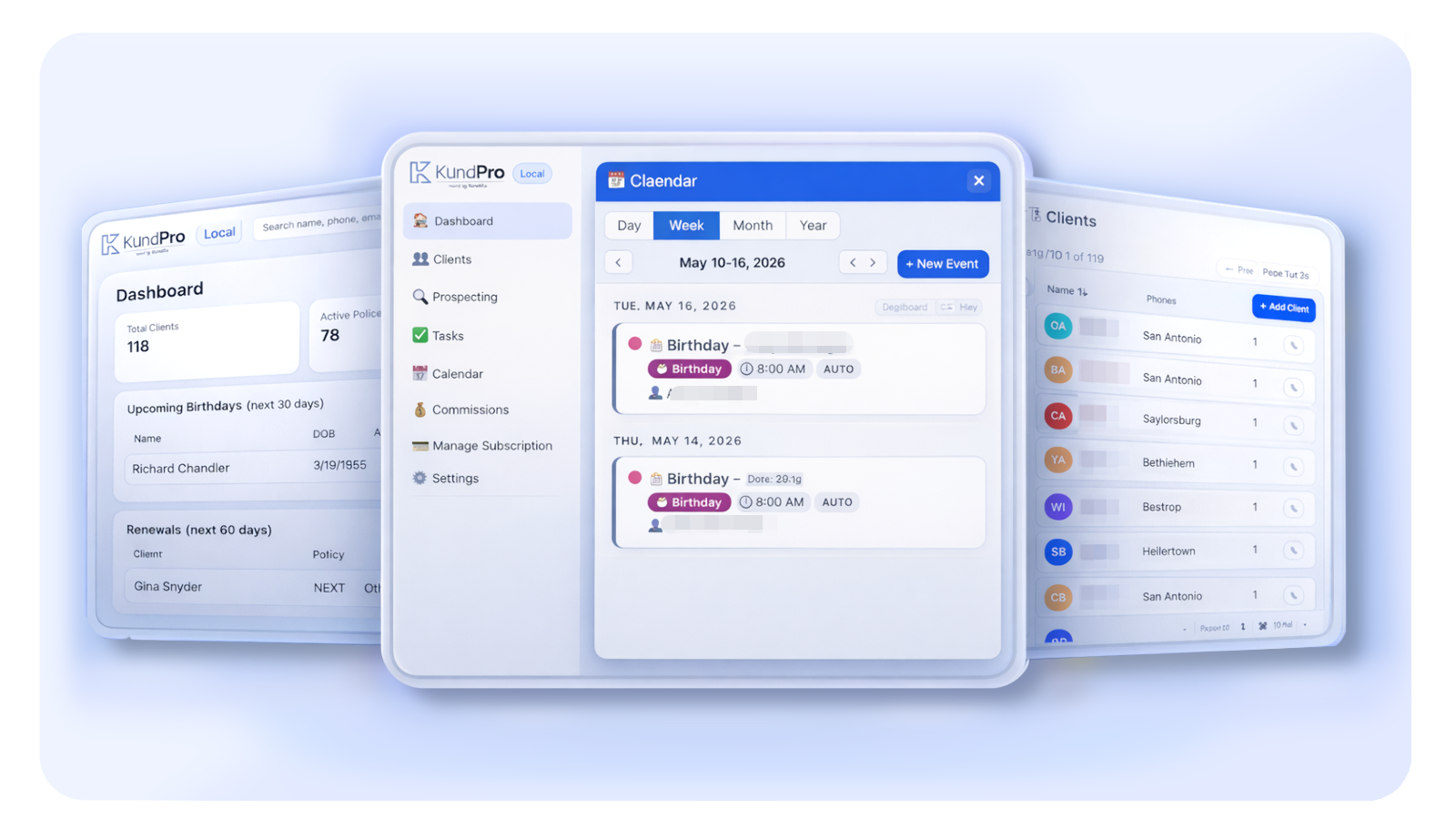
That's the problem KundPro was built to solve. It doesn't replace your dialer. It doesn't replace your texting platform. It organizes everything after the conversation: clients, policies, carriers, commissions, and renewals — all in one place, structured the way a Medicare book actually operates.
Think of it this way: the contact card helps you get the conversation. KundPro helps you keep control of what happens next.
- Full book-of-business management — clients, policies, commissions, renewals
- Multi-product tracking per client — one record, multiple policies attached
- Policy-level commission tracking — NFYC and renewals per carrier
- Prospecting tools built from inside your existing book
- Form Broadcast — client data flows forward into carrier applications
- Data export — your book is yours, always
- Flat pricing — no contact-count scaling as your book grows
Free beta access is currently available for a limited number of agents. Beta users who remain on the platform at full launch will receive a permanent 40% discount on the standard monthly rate — locked in for as long as they stay subscribed.
Or just keep using the contact card tool — it'll improve your contact rate either way.
Common questions
Answers to what agents ask most often about contact rates, spam labeling, and the contact card approach.
Fresh leads from shared lead vendors have often already received multiple calls from unknown numbers by the time you dial. Their phones have been trained — through repeated ignoring of unknown callers — to treat unrecognized numbers as low priority. The lead being "fresh" doesn't mean your number is trusted. Establishing a prior SMS interaction before calling is the most direct way to change how your number is scored on that specific device.
Calls get marked as spam when your number accumulates negative signals — high outbound volume, unanswered call rates, or recipient reports — that carrier and OS-level systems flag as suspicious. There are two approaches: prevention and remediation. Prevention means establishing prior SMS interaction before you call (which is what the contact card does), keeping dial volume per number reasonable, and registering through STIR/SHAKEN attestation so your number passes carrier verification. If your number is already labeled, submit a remediation request through Free Caller Registry, TNS, or First Orion — these are the three main databases carriers reference. In severe cases, the number needs to be retired. The contact card prevents the problem from developing; it's not a fix for a number that's already deeply flagged.
Local presence has become significantly less effective. Numbers that rotate across area codes or show high-volume outbound dial patterns are detected and flagged by carriers and phone operating systems. Many agents report their local presence numbers being labeled "Scam Likely" within weeks. The underlying strategy — trying to appear local to increase pick-up rates — has been largely countered by call screening technology that evaluates dial patterns rather than just the number itself.
When a call goes straight to voicemail without the phone ever audibly ringing, it means the call was intercepted and suppressed before reaching the recipient's device — not ignored after it rang. This happens when a carrier or the phone's operating system evaluates your number, finds no prior trust signals, and routes the call silently to voicemail. The recipient may never even see a missed call notification. It is not the same as the prospect choosing not to answer — they often have no idea you called. The fix is establishing a prior interaction record before you dial: a text with your contact card creates that record, changing how the system scores your number on that specific device.
Medicare-eligible adults are one of the most heavily targeted demographics for phone scams, Medicare fraud calls, and unsolicited telemarketing. As a result, carriers apply more aggressive filtering to calls directed at this demographic, and many individuals in this age group have configured their phones to silence unknown callers entirely. Ironically, this means legitimate licensed agents are filtered alongside actual scammers. Establishing prior SMS interaction and getting your name into their contacts before calling is especially important in this market.
The filtering technology has improved dramatically and the volume of actual robocalls and scam calls has trained both systems and people to be far more defensive. STIR/SHAKEN protocols now authenticate caller ID at the carrier level. iOS and Android both apply machine learning that evaluates call volume patterns, unanswered call ratios, and user reports to decide whether your call should be surfaced or suppressed. The result is that the same list, the same script, and the same dialer that worked well five years ago now produces a fraction of the conversations — not because the leads are worse, but because the path between you and the prospect is far more contested.
Power dialing as a standalone strategy is in serious decline — but not because dialing tools are broken. The problem is that high-volume dialing from a single number without any prior interaction generates patterns that spam-detection systems recognize and flag, often within days. Every call you make from a flagged number is less likely to be answered than the last. The agents who are still getting results from their dialers are the ones who establish pre-call recognition first — sending a contact card before the first dial attempt on any new number. The dialer is still useful. Leading with it cold is what stopped working.
The highest-leverage changes for improving contact rate as an insurance agent, in order of impact: first, establish pre-call recognition by sending a digital contact card via text before your first dial on any new number — this is the single biggest move most agents aren't making. Second, register your number through STIR/SHAKEN attestation and submit for allowlisting through Free Caller Registry so carriers verify your identity. Third, call during hours when your demographic answers — mid-morning works well for Medicare-aged prospects. Fourth, keep dial volume per number reasonable to avoid triggering automated spam flags. Fifth, invest in lead quality over quantity — a smaller set of well-sourced leads with prior interaction consistently outperforms a large volume of cold dials from flagged numbers. Most agents focus on dials. The real lever is recognized dials.