
What is insurance commission tracking software?
Insurance commission tracking software is used by agents and agencies to monitor payments from insurance carriers, including first-year commissions (NFYC) and renewal commissions. Most systems track commissions after they are paid using carrier statements, spreadsheets, or CRM reports.
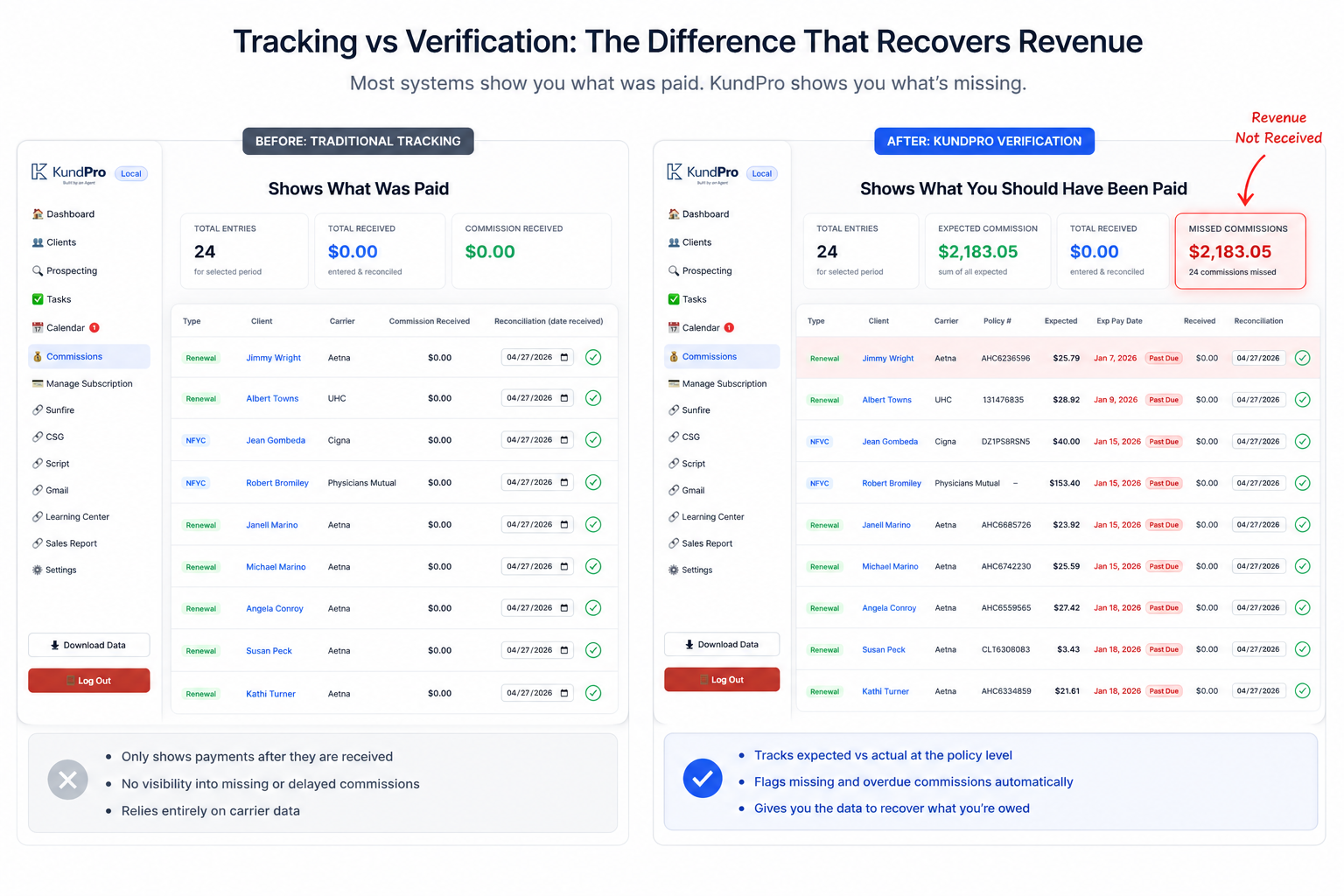
However, traditional commission tracking software has a core limitation: it only records what carriers report. It does not define what should have been paid. This means missed or incorrect commissions often go undetected — invisible until the agent manually audits every carrier statement against their own records.
Modern systems like KundPro take a different approach — combining tracking with verification by comparing expected commissions at the policy level against actual payments received. This is the only approach that catches missed commissions automatically, without requiring the agent to catch them manually.
The real problem with commission tracking
Most Medicare agents think they are tracking commissions.
In reality, they are recording payments after they arrive. If a carrier misses a payment, delays a commission, or underpays a policy — most systems never notice. There is nothing to compare against, so nothing triggers an alert.
The commission is simply invisible until the agent manually cross-references a carrier statement against their own records — assuming they have records that are current enough to catch it.
What most commission tracking systems do well
Modern CRM and AMS platforms are genuinely good at the basics:
- Importing carrier statements and commission feeds
- Organizing payments by carrier, policy type, or agent
- Generating commission reports and summaries
- Tracking payments that have already arrived
They are good at processing data. If a carrier sends a commission, these systems will record it, categorize it, and include it in your reports.
But processing data is not the same as verifying it.
Where commission tracking breaks down
Most systems rely on one of three data models:
- Carrier data feeds — automated imports from carrier commission systems
- Rate tables — pre-loaded commission schedules by plan and carrier
- Manual statement import — the agent uploads or enters what the carrier reported
All three share the same structural flaw: they assume the carrier data is correct.
This is not a fringe problem. Carriers make errors. Payment schedules shift. Policies lapse and reactivate. Commission rates change. For Medicare agents managing hundreds of policies across dozens of carriers, the surface area for undetected errors is significant.
Commission tracking vs commission verification
Tracking records what happened. Verification audits whether what happened matches what should have happened.
- Carrier sends payment
- System records the amount
- Commission appears in reports
- If no payment arrives — silence
- Relies entirely on carrier data
- Policy is written — expected commission defined
- Expected pay date set in the record
- Carrier pays — actual amount recorded
- System compares expected vs actual
- Discrepancy or miss — flagged immediately
Traditional systems act as a filing cabinet for payments that arrived. KundPro acts as an auditor — defining what should arrive, tracking when it should arrive, and flagging every instance where reality does not match the expectation.
This is the difference between tracking commissions and recovering revenue.
Insurance commission tracking software comparison
| Feature | Traditional CRM / AMS | KundPro |
|---|---|---|
| Source of truth | Carrier data / carrier statement | Your book of business — policy-level records you define |
| Tracks payments received | ✓ | ✓ |
| Defines expected commissions per policy | ✗ | ✓ |
| Tracks NFYC separately from renewals | Limited | ✓ Both, per policy |
| Detects missing commissions | ✗ | ✓ |
| Verifies payments against expected | ✗ | ✓ |
| Flags overdue commissions | ✗ | ✓ Show Missed Only filter |
| Commission forecasting by month | ✗ | ✓ |
| Handles multi-carrier variability | Limited | ✓ Per-policy, per-carrier |
| Requires carrier feed or API | Often required | ✗ No dependency on carrier data |
| Commission ledger sorted by month | ✗ | ✓ Bank-statement style ledger |
Example: Missing $312 commission found
Here is a real-world scenario that happens every day for Medicare agents.
Expected first-year commission (NFYC): $312
Expected pay date: January 20
Policy status: Active. Client is covered. Everything looks correct.
But the payment never arrives.
What happens next — two systems, two outcomes
Both systems know the policy exists. Only KundPro knows what payment was expected and when.
No carrier payment was recorded. No entry appears in the system. No alert is triggered. The commission is invisible. The agent has no way to know $312 is missing unless they manually audit every carrier statement against their own records.
The policy has an expected commission of $312 with an expected pay date of January 20. That date has passed. No payment was entered and reconciled. The ledger flags it as a missed commission — immediately visible in the dashboard and in the Show Missed Only filter.
Status: Unpaid — Past Due
Action: Follow up with carrier for this specific policy, carrier, and payment period
This is powered by policy-level commission tracking — not carrier feeds or rate tables. See how Medicare agents track and verify commissions in KundPro →
The outcome
The agent contacts the carrier, identifies the issue, and receives the missing payment.
Revenue recovered: $312
Without a verification system, this commission would not appear anywhere — not in your CRM, not in your reports, and not in your bank account.
This is also one of the clearest illustrations of why Medicare agents still use spreadsheets alongside their CRM → — neither their CRM nor their spreadsheet was built to catch this kind of miss automatically.
This is the difference between tracking commissions and verifying them. Without verification, that commission is lost. With verification, it is recovered.
To understand how this fits into the full Medicare book-of-business workflow: best CRM for managing a Medicare book of business →
How many commissions are you missing?
Most agents never know. KundPro makes them visible — before they disappear.
Start Verifying →No credit card required • Medicare agents only • Private beta
How commission verification actually works
KundPro starts at the policy level — where commissions originate — not at the carrier statement where most systems begin.
Expected commission entry
When you write a policy, you enter the expected NFYC commission amount and expected pay date. KundPro creates a ledger entry. The system now knows what you are owed and when — independently of the carrier.
- NFYC amount per policy
- Renewal commission amount
- Expected pay date
- Renewal frequency (monthly, quarterly, annual)
Expected vs actual comparison
When a carrier pays, you record the actual amount received. The system compares it against what was expected. Anything that does not match — or anything that does not arrive — is immediately visible.
- Flags missed commissions by pay date
- Shows discrepancies between expected and received
- Show Missed Only filter for fast auditing
- Commission forecasting by month across the book
Same workflow, both commission types
First-year and renewal commissions follow the exact same expected-versus-actual process. Both appear in the same ledger, reconciled the same way, tracked the same way.
- NFYC tracked at the policy level
- Renewal commissions tracked per policy, per carrier
- Rate changes reflected in the expected amount
- History of every payment across every renewal year
See what is coming before it arrives
Because every expected commission is in the system before the carrier pays, the ledger can project what your book should generate in any future month — across every carrier and every policy.
- Monthly commission forecast across the book
- Per-carrier expected revenue by period
- Early warning when expected income drops
- Book valuation based on expected renewal income
Built by a Medicare agent who got tired of missing commissions
After twenty years in Medicare sales, I’ve experienced every version of this problem. Carrier feeds that miss policies. Rate tables that do not match actual contracting. Spreadsheets that are always slightly out of date. And the slow realization that commissions I should have been paid just… weren’t. And I had no easy way to know which ones, from which carriers, for which policies.
That is why KundPro’s commission module starts with expected commissions — not carrier data. The source of truth is your book of business, defined by you, at the policy level. The carrier data is what gets checked against it — not the other way around.
I’ve seen commissions missed. I’ve chased them. That’s why this exists.
The verdict: tracking is not enough for Medicare agents
Commission tracking software tells you what you received. For agents managing a multi-carrier Medicare book with dozens of NFYC entries and hundreds of renewal commissions across the year, that is not enough.
You need a system that tells you what you should have received — and flags immediately when the two numbers do not match.
Most tools track what you got paid. KundPro verifies what you were supposed to get paid.
The difference, for most agents, is hundreds to thousands of dollars per year in recovered commissions.
Related guides
Frequently asked questions
Insurance commission tracking software records and organizes commission payments from carriers across policies, agents, and time periods. Most platforms import carrier statements, track payments received, and provide reporting. The limitation: they only reflect what carriers report. If a carrier misses a payment or underpays a policy, most systems have no way to detect it.
Commission tracking records what was paid. Commission verification audits whether what was paid matches what should have been paid. Traditional systems act as a filing cabinet for payments as they arrive. A verification system starts by defining what each policy should generate, when, and from which carrier. Any discrepancy — a missed payment, an underpayment, a delayed commission — is flagged immediately rather than discovered later, if at all.
Most Medicare agents use a spreadsheet alongside their CRM — because most CRM platforms do not track commissions at the policy level. The agent manually reconciles carrier statements against their own records each month. More advanced agents use a policy-level ledger where the expected commission is entered when the policy is written, and actual carrier payments are compared against that expectation. The second approach is the only one that catches missed or incorrect commissions.
Medicare agents miss commission payments because most tracking systems only record what carriers send — they do not define what carriers should send. If a carrier skips a monthly renewal commission or underpays a NFYC, the system has nothing to flag the error against. The agent only discovers the miss if they manually notice the payment is absent, which requires reviewing multiple carrier statements each month. As the book grows, this becomes increasingly difficult to maintain reliably.
Policy-level commission tracking means NFYC and renewal commissions are tied directly to the individual policy record — not aggregated in a report or imported from a carrier feed. When you write a policy, you enter the expected commission amount and expected pay date. The system creates a ledger entry. When the carrier pays, you record the actual amount. The system compares expected versus actual and flags any discrepancy. This is the only approach that gives you the data to recover commissions that were missed or underpaid.
AgencyBloc treats commissions as a reporting layer — commissions are aggregated and surfaced through reports rather than tied to individual policy records. MedicarePRO CRM does not include native commission tracking at the policy level. KundPro treats commissions as part of the policy itself — expected amount, expected date, actual received, actual date, reconciled or flagged. Both NFYC and renewal commissions follow the same workflow. The ledger shows what is coming before it arrives and flags what was missed the moment a pay date passes without a matching payment.
NFYC stands for Net First Year Commission — the commission paid to an agent in the first year a client is enrolled in a plan. It is distinct from renewal commissions, which are paid in subsequent years at a lower CMS-set rate. For Medicare agents, tracking both separately at the policy level is essential for accurate book valuation and for identifying when a carrier has missed or underpaid either type.
Industry analysis estimates 3 to 5 percent of commissions owed annually are missed or unrecovered by agents using spreadsheet-based or report-based tracking. For an agent with a mature book generating $50,000 or more in annual commissions, that represents $1,500 to $2,500 in unrecovered revenue each year — money that exists in the system but was never flagged as missing.